Mood Changes During Midlife: What Women May Notice and What May Be Related
Mood can vary throughout life. During midlife, however, some women may notice that they feel more irritable, more emotional, or that changes in mood seem more noticeable than they were before.
For some women, these changes may feel new. Others may recognize similar experiences from earlier periods of life but notice them differently during midlife. Some women may notice little or no meaningful change at all.
There is no single emotional pattern that applies to every woman during this stage of life. Midlife can coincide with reproductive aging as well as changes in sleep, health, stress and life circumstances. Several of these factors may be relevant at the same time.
Noticing a change in mood during midlife therefore does not, by itself, explain why that change is happening.
What Do Mood Changes Mean?
The phrase mood changes can describe different experiences.
A woman may notice that she feels more irritable than usual, becomes emotional more easily, or simply feels that her emotional responses seem different from what she is accustomed to.
These experiences can vary in frequency, intensity and duration. They may also occur in different situations and may not follow the same pattern from one woman to another.
Feeling irritable or more emotional does not automatically indicate depression, anxiety or another mental health condition.
Mood Changes Can Be Noticed in Different Ways During Midlife
Women do not experience mood changes in one universal way during midlife.
Some may notice greater irritability. Others may feel more emotionally sensitive or notice that their mood seems less predictable than before. Some women may experience several of these changes, while others may experience none.
The words women use to describe these experiences can also differ. One person may describe herself as more irritable, while another may say that she feels more emotional or that her mood seems to change more easily.
These descriptions can overlap, but they should not be treated as if they always describe the same experience.
This variability is one reason mood changes during midlife should not be reduced to a single symptom or explanation.
Why Midlife Does Not Point to a Single Explanation
When a change becomes noticeable during midlife, it can be tempting to assume that age itself explains what is happening.
But timing does not establish cause.
Midlife can coincide with several changes in a woman's physical, emotional and personal context. Reproductive aging may be occurring alongside changes in sleep, health, stress and everyday circumstances.
The relevance of these factors differs between individuals, and more than one may be present at the same time.
A woman's age therefore cannot, by itself, explain why she has noticed a change in her mood.
How the Menopausal Transition May Be Related to Mood Changes
The menopausal transition may be associated with changes in mood for some women, including changes in irritability or emotional well-being.
However, the experience is not the same for every woman.
Research examining women during the menopausal transition suggests that emotional experiences can vary considerably and that reproductive aging occurs within a broader health and life context.
Hormonal changes are part of the menopausal transition, but their presence does not establish why an individual woman feels more irritable, emotional or different in her mood.
A mood change occurring during this stage therefore should not automatically be attributed to menopause or to a particular hormonal change.
The menopausal transition may be part of the context without being assumed to be the individual explanation.
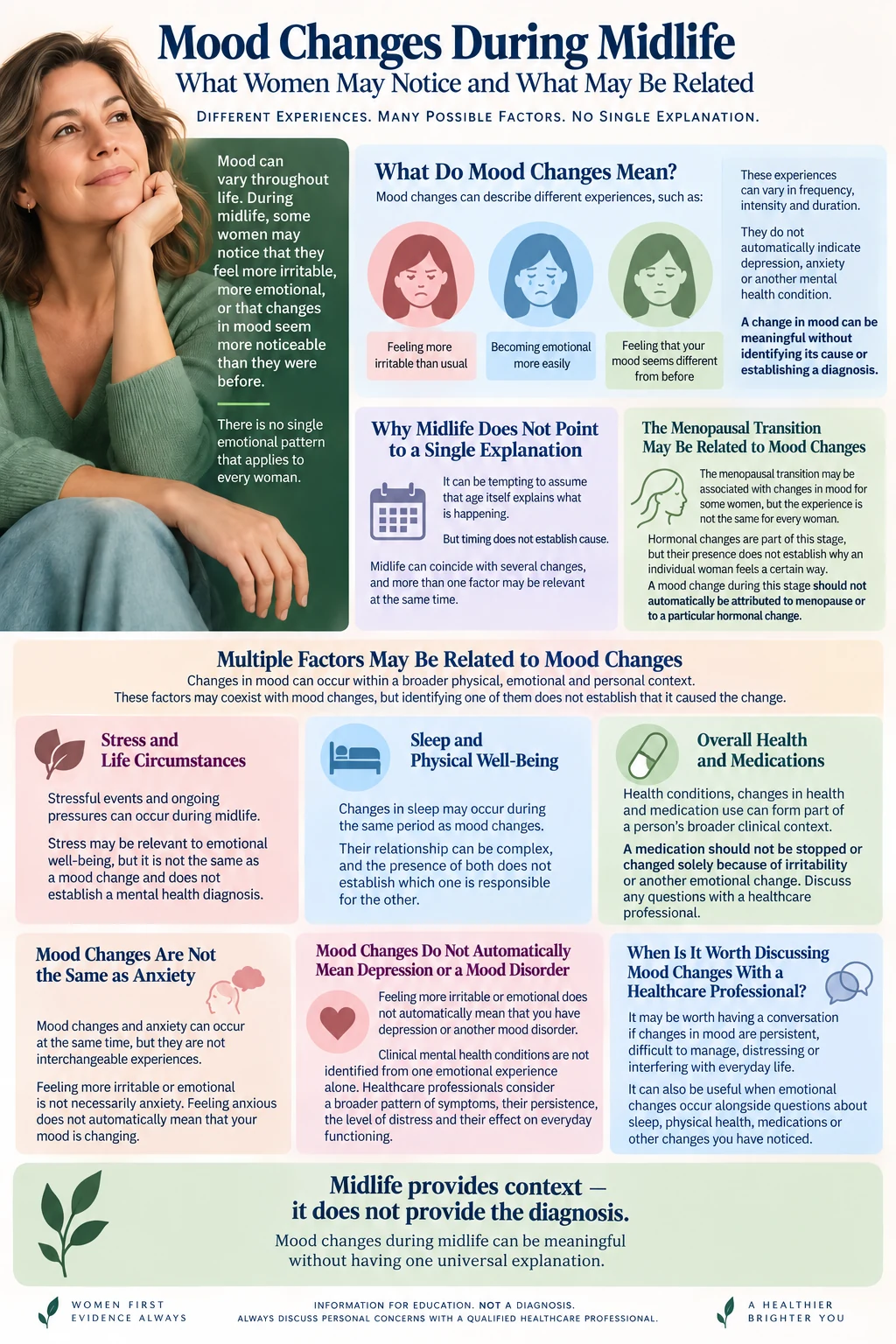
Multiple Factors May Be Related to Mood Changes
Changes in mood can occur within a broader physical, emotional and personal context.
Several areas of a woman's health and life may be relevant when changes in emotional well-being are considered.
These factors may coexist with mood changes, but identifying one of them does not establish that it caused the change in an individual woman.
Stress and Life Circumstances
Stressful events and ongoing pressures can occur during midlife, just as they can during other stages of life.
Stress may be relevant to emotional well-being, but stress and mood changes are not interchangeable.
A woman may notice irritability or feel more emotional during a stressful period without that observation explaining the entire change in her mood.
Likewise, the presence of stress does not establish a mental health diagnosis.
Life circumstances can provide useful context, but they should not be treated as a universal explanation for how women feel during midlife.
Sleep and Physical Well-Being
Sleep and emotional well-being can be related, and changes in sleep may occur during the same period in which a woman notices changes in her mood.
Their relationship, however, can be complex.
The presence of both does not establish which one is responsible for the other, and the relationship may differ between individuals.
A woman who is experiencing changes in nighttime sleep may therefore find it useful to consider those changes separately rather than assuming that one symptom explains the other.
Overall Health and Medications
Overall physical health can also be relevant when changes in emotional well-being are being considered.
Health conditions, changes in health and medication use can form part of an individual's broader clinical context. Their relevance depends on the person and cannot be determined from a change in mood alone.
A medication should not be stopped or changed solely because a woman has noticed irritability or another emotional change.
Questions about whether a health condition or medication could be relevant are better discussed with a healthcare professional who can consider the woman's health history and circumstances.
Mood Changes Are Not the Same as Anxiety
Mood changes and anxiety can occur at the same time, but they are not interchangeable experiences.
A woman who feels more irritable or emotional is not necessarily experiencing anxiety. Likewise, feeling anxious does not automatically mean that a woman's mood is changing.
The distinction matters because different emotional experiences can overlap without having the same meaning or explanation.
For women who specifically notice that worry, nervousness or anxiety has become more prominent, that experience can be considered separately rather than assuming it is simply another form of a mood change.
Mood Changes Do Not Automatically Mean Depression or a Mood Disorder
Feeling more irritable, emotional or noticing changes in mood does not automatically mean that a woman has depression or another mood disorder.
Clinical mental health conditions are not identified from one emotional experience alone. Healthcare professionals consider a broader pattern of symptoms, their persistence, the level of distress and their effect on everyday functioning, among other aspects of an individual's clinical context.
There is therefore no single mood change described in this article that can establish a mental health diagnosis.
Similarly, experiencing mood changes during midlife or the menopausal transition should not automatically be labeled as depression or another mood disorder.
Recognizing this distinction allows a woman's experience to be taken seriously without turning the experience itself into a diagnosis.
When Is It Worth Discussing Mood Changes With a Healthcare Professional?
If changes in mood are persistent, difficult to manage, distressing or interfering with everyday life, discussing them with a healthcare professional may be appropriate.
A conversation may also be useful when emotional changes occur alongside questions about sleep, physical health, medications or other changes a woman has noticed.
Seeking professional advice does not mean that depression, anxiety or another mental health condition is necessarily present.
It allows the woman's emotional experience, health history and individual circumstances to be considered together rather than assuming that midlife, menopause or any single factor explains what she is experiencing.
Mood changes during midlife can be meaningful without having one universal explanation.
Sources
- American College of Obstetricians and Gynecologists (ACOG) — Mood Changes During Perimenopause
- Office on Women's Health — Menopause Symptoms and Relief
- Prospective Cohort Research — Psychological and Physical Symptoms Across Midlife
- Prospective Longitudinal Research — Menopausal Transition and Psychological Symptoms
- SWAN — Reproductive Hormones and Depressive Symptoms During the Menopausal Transition
- National Institute of Mental Health — Depression