You may be able to follow a conversation easily in a quiet room but struggle to understand the same person in a busy restaurant, at a family gathering, or anywhere several sounds compete for your attention.
That difference can be frustrating, but it also highlights an important point: hearing speech in quiet and understanding speech in background noise are not the same listening task.
A conventional hearing test can provide valuable information about hearing sensitivity. However, everyday listening often involves much more than detecting sounds in a quiet environment. Background conversations and other competing sounds can make speech more difficult to understand.
Difficulty understanding speech in noise is a listening complaint — not a diagnosis by itself. A hearing evaluation can help characterize the difficulty and determine whether additional testing is appropriate.
Why Is Speech Harder to Understand in Background Noise?
Hearing Speech in Quiet vs Understanding Speech in Noise
In a quiet setting, there may be relatively little competing sound between you and the person speaking. In a noisy environment, the listener is trying to understand the target speech while other sounds are present at the same time.
That makes the listening situation more demanding.
This is one reason someone may notice that conversation seems relatively easy at home but much harder in a crowded restaurant or group setting.
The difference does not, by itself, identify the cause of the difficulty. It shows that performance in quiet does not necessarily describe how someone will perform in more complex listening environments.
How Competing Sounds Make Listening More Demanding
Background noise can overlap with parts of speech and make the speech signal harder to distinguish.
The difficulty can change depending on the listening environment. The level and type of background sound, the level of the speech signal, and other characteristics of the listening situation can all affect how challenging communication becomes.
For this reason, hearing speech in a quiet testing environment and understanding speech when competing sounds are present provide different information about listening performance.
Can You Have Trouble Understanding Speech in Noise Even if Pure-Tone Thresholds Are Clinically Normal?
Yes. Some people report difficulty understanding speech in noise even though their conventional pure-tone thresholds fall within the clinically normal range. This presentation has also been examined in hearing research.
That does not mean a conventional audiogram is unimportant or that it has “missed” a specific disorder. It means that pure-tone thresholds and performance in complex listening situations address different questions.
Why Pure-Tone Thresholds and Speech-in-Noise Performance Measure Different Things
Pure-tone audiometry measures hearing sensitivity across tested frequencies.
Speech-in-noise testing asks a different question: how well can speech be understood when competing sound is also present?
Both types of information can be useful, but one should not automatically be treated as a substitute for the other. Audiologic evaluation may include both pure-tone audiometry and measures of speech understanding in quiet and in noise.
Why an Audiogram Does Not Capture Every Real-World Listening Situation
An audiogram is an important clinical record of hearing thresholds, but everyday communication rarely consists of isolated tones presented in a controlled environment.
Real conversations may involve multiple speakers, competing sound, different distances and changing acoustic conditions.
For that reason, clinically normal pure-tone thresholds do not guarantee identical performance across every real-world listening situation.
This distinction should not be interpreted as proof of a particular “hidden” disorder. It simply reflects the fact that a conventional audiogram and complex listening tasks measure different aspects of auditory performance.
What Is a Speech-in-Noise Test?
Speech-in-noise testing is used to assess speech understanding when competing noise is present.
Rather than asking only whether a person can detect a sound, these tests examine how speech is recognized under more challenging listening conditions. Speech-in-noise testing can provide information about hearing under conditions that more closely reflect some real-world listening situations.
How Speech-in-Noise Testing Works
There is more than one type of speech-in-noise test.
Depending on the test, a listener may hear words or sentences while another sound is presented at the same time. The clinician may use different types of speech material, presentation levels and background noise.
Some procedures keep the relationship between speech and noise fixed. Others change the speech or noise level during the test to examine performance under different conditions.
The exact procedure and interpretation depend on the test being used and the broader hearing evaluation.
What Signal-to-Noise Ratio (SNR) Means
Signal-to-noise ratio, or SNR, describes the relationship between the target signal — in this case, speech — and the competing noise.
Conceptually, when speech stands out more clearly from the background sound, the listening task may be easier. As the competing sound makes the speech less distinct, understanding can become more difficult.
SNR is therefore useful in speech-in-noise assessment, but an SNR value should not be treated as a do-it-yourself measure of how much hearing loss someone has.
Its meaning depends on the specific test, procedure and clinical context.
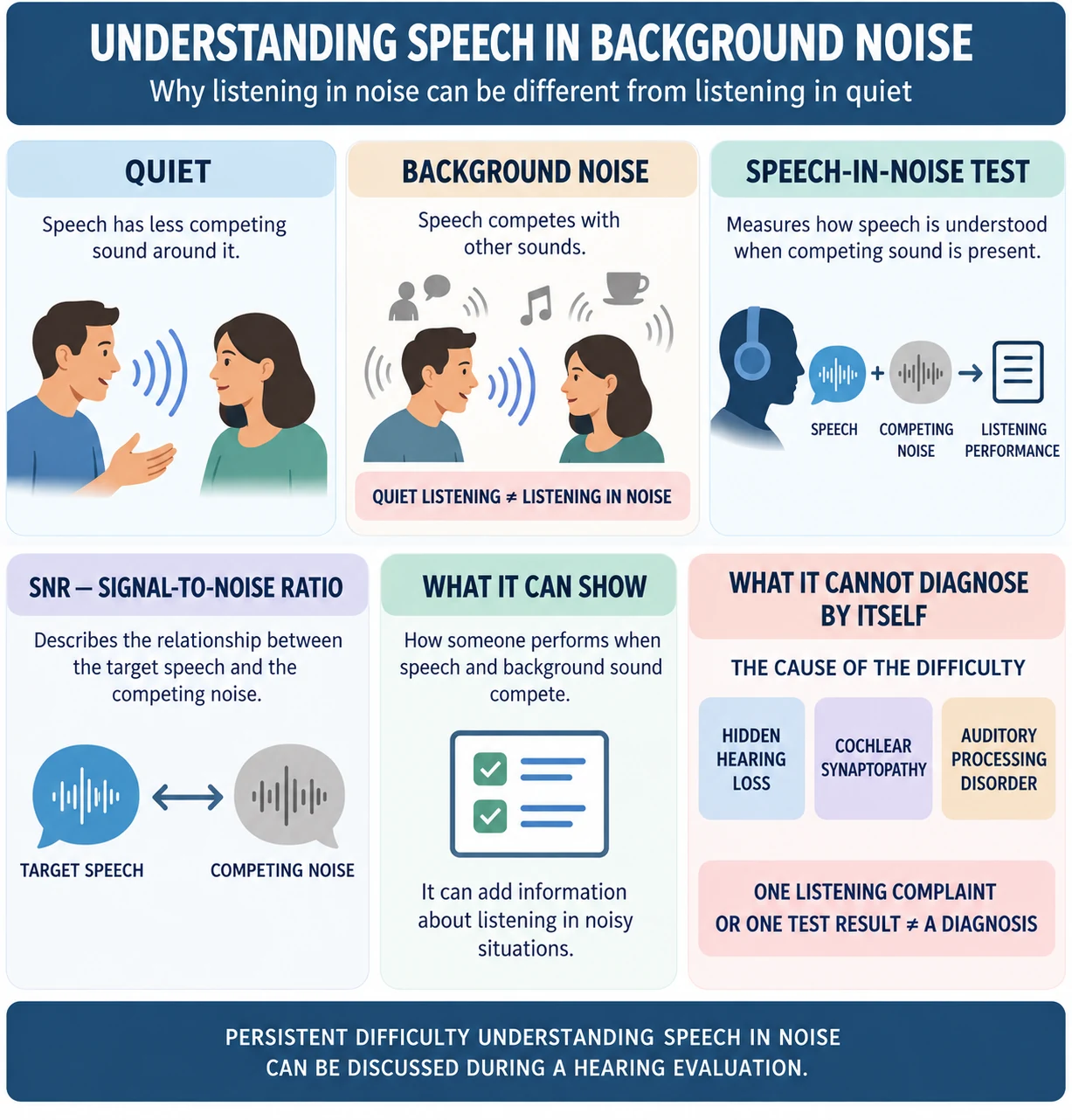
Speech-in-noise testing can add information about listening when speech and competing sound are present, but one listening complaint or one test result is not a diagnosis.
What Can Speech-in-Noise Testing Show?
How It Adds Information About Listening in Noisy Situations
Speech-in-noise testing can provide information about how someone performs when speech competes with background sound.
This can be useful when a person's everyday complaint involves environments such as restaurants, meetings, social gatherings, or other situations where several sounds occur at once.
Importantly, results obtained with background noise can differ from results obtained with speech presented in quiet.
That additional information can help describe the listening difficulty more completely.
Why the Result Does Not Diagnose the Cause by Itself
A speech-in-noise result describes performance under the conditions of that particular assessment. It does not, by itself, establish why the difficulty occurred.
Audiologists interpret a test battery in the context of the person’s medical and developmental history.
This distinction is particularly important because difficulty understanding speech in noise can occur in more than one clinical or functional context.
Does Difficulty Understanding Speech in Noise Mean “Hidden Hearing Loss”?
Not necessarily.
The term “hidden hearing loss” has been used in discussions of auditory difficulties that may not be apparent on conventional pure-tone testing.
Why Difficulty in Noise Does Not Identify a Specific Cause
Cochlear synaptopathy has been investigated as one possible mechanism in people who report difficulty understanding speech in noise despite clinically normal pure-tone thresholds. However, human studies have not established a simple relationship between this complaint and cochlear synaptopathy, and recent research continues to show that difficulty in noise cannot be used by itself to identify that mechanism.
These findings do not settle every scientific question about cochlear synaptopathy. They do show why a listening complaint should not be converted into that diagnosis without appropriate clinical evidence.
Does Difficulty Hearing in Noise Mean Auditory Processing Disorder?
Not by itself.
Difficulty understanding speech in noise can occur in different contexts, and one listening complaint is not enough to establish auditory processing disorder or another specific diagnosis.
Why One Listening Complaint Is Not Enough for a Diagnosis
A person may describe where and when communication becomes difficult, but those experiences need to be interpreted within a broader evaluation.
Hearing assessment may involve multiple measures, and the appropriate test battery depends on the person's history, symptoms and clinical findings.
The complaint can be important without telling us its cause.
What Should You Do if Understanding Speech in Noise Is Difficult?
Keep Track of the Listening Situations That Are Difficult
It can be useful to notice the circumstances in which the problem occurs.
For example, is conversation difficult mainly when several people are speaking? Does it become harder when the speaker is farther away? Is the difficulty mostly noticeable in restaurants, meetings, group conversations, or other noisy environments?
This kind of information does not diagnose a hearing condition. It gives the hearing professional a clearer picture of the communication situations that are causing difficulty.
When to Discuss the Problem During a Hearing Evaluation
If difficulty understanding speech in background noise is persistent or is interfering with communication, it is reasonable to bring the specific complaint to a hearing professional.
A hearing evaluation can examine hearing sensitivity and other aspects of auditory performance as appropriate. Depending on the individual situation, the clinician can determine whether speech-in-noise testing or other measures may add useful information.
If you want to understand how conventional hearing testing and audiograms work, see our guide to Hearing Tests and Audiograms.
The goal of evaluation is to characterize the difficulty in context.
Conclusion
Understanding speech in background noise places different demands on listening than hearing speech in a quiet environment.
A conventional audiogram provides important information about hearing sensitivity, while speech-in-noise assessment can add information about performance when competing sound is present. Neither a complaint nor a single test result automatically identifies the underlying cause.
Difficulty understanding speech in noise is real information about listening — but it is not a diagnosis by itself.
Sources
Vitality Product Hub prioritizes major professional sources and peer-reviewed research for medical and hearing-health content.
- American Speech-Language-Hearing Association (ASHA) — Hearing Loss in Adults
- ASHA — Central Auditory Processing Disorder
- Peer-reviewed research — Speech-in-noise performance and self-reported hearing difficulty in adults with normal audiograms
- Guest et al. — Impaired Speech Perception in Noise with a Normal Audiogram: No Evidence for Cochlear Synaptopathy and No Relation to Lifetime Noise Exposure
- Peer-reviewed review — Cochlear synaptopathy and hidden hearing loss in humans
- Arora & Maruthy (2026) — Study of speech-in-noise difficulty in adults with clinically normal standard-frequency audiograms