Hearing aids are available through more than one pathway in the United States. Some hearing aids are available over the counter, while prescription hearing aids follow a licensed professional pathway.
That distinction can be confusing. An OTC hearing aid is not simply a hearing device purchased online, and a prescription hearing aid is not merely a more powerful version of an OTC device. Terms such as self-fitting and personal sound amplification product also describe different concepts and should not be used interchangeably.
Understanding these categories can make hearing-aid information easier to interpret without trying to determine on your own which device is appropriate for a particular hearing problem.
What Is a Hearing Aid?
A hearing aid is a medical device intended to help compensate for hearing impairment by receiving, processing and amplifying sound.
In the United States, hearing aids are regulated by the Food and Drug Administration (FDA). Both OTC and prescription hearing aids fall within the broader hearing-aid category.
How Hearing Aids Differ From General Sound Amplification
Amplifying sound does not automatically make a product a hearing aid.
What matters is partly the product's intended use. Hearing aids are intended to compensate for impaired hearing. Other products may amplify sound for different purposes without being intended for hearing loss.
This distinction becomes especially important when comparing hearing aids with personal sound amplification products, or PSAPs.
Why Hearing Aids Are Regulated as Medical Devices
Because hearing aids are intended for people with hearing impairment, they are regulated as medical devices in the United States.
As medical devices, hearing aids are subject to FDA regulatory requirements. The requirements that apply depend in part on the device category and classification.
What Is an OTC Hearing Aid?
The FDA established the OTC hearing-aid category to expand access to hearing aids for a defined adult population.
OTC hearing aids are certain air-conduction hearing aids that can be purchased directly by consumers without the involvement or prescription of a licensed health care professional.
Who OTC Hearing Aids Are Intended For
In the United States, OTC hearing aids are intended for people 18 years of age or older with perceived mild to moderate hearing loss.
The word perceived matters. The FDA's OTC category is based on its defined intended-use population; it should not be converted into a do-it-yourself audiogram rule or a single decibel cutoff for choosing a device.
OTC hearing aids are not intended for children. They also are not intended to treat severe or profound hearing loss.
What “Over the Counter” Means
For eligible adults, OTC means the hearing aid can be purchased without a medical examination, prescription or fitting adjustment by an audiologist as a condition of the sale.
OTC hearing aids may be sold in stores or online. They may also be obtained from a hearing health care professional.
The term therefore describes a regulatory pathway — not simply a place where a device happens to be sold.
What Is a Prescription Hearing Aid?
Under the FDA framework, a prescription hearing aid is a hearing aid that does not meet the definition of an OTC hearing aid.
Prescription hearing aids are available through licensed hearing health care professionals. Depending on their indications for use, they may be appropriate for people of different ages and for different degrees of hearing loss.
How the Prescription Hearing Aid Pathway Works
The prescription pathway involves a licensed hearing health care professional who can assess hearing and select, program or fit hearing aids according to an individual's hearing and communication needs.
This professional pathway should not be confused with a universal federal requirement for every adult to undergo a medical examination before receiving a prescription hearing aid.
The FDA states that it does not require a medical examination or hearing test for prescription hearing aids, although state requirements may differ. Special requirements also apply to people younger than 18.
How the Intended Use of Prescription Hearing Aids Differs From OTC
The OTC category has a specifically defined intended population: adults 18 and older with perceived mild to moderate hearing loss.
Prescription hearing aids are not limited to that OTC population. Depending on their indications for use, prescription devices may be used across different ages and degrees of hearing loss.
OTC vs Prescription Hearing Aids: What Actually Differs?
Both OTC and prescription products are hearing aids, and both are regulated medical devices. The distinction lies in their regulatory categories, intended users and conditions of sale.
Access and Professional Involvement
OTC hearing aids allow adults in the intended population to purchase a device directly without a prescription or mandatory professional fitting.
Prescription hearing aids are obtained through a licensed professional pathway.
Professional care, however, is not synonymous with the word prescription. An adult may still choose to have a hearing evaluation before considering an OTC device even though such an evaluation is not required to purchase one.
Fitting, Adjustment, and Customization
OTC hearing aids must allow users to control the device and customize it to their hearing needs through controls, tools, tests or software.
Some OTC devices offer relatively straightforward controls such as volume adjustments or preset programs. Others use self-fitting technology that provides greater customization through software, hearing tests or smartphone applications.
Prescription hearing aids may be programmed and fitted by a hearing health care professional according to an individual's hearing needs.
Why the Difference Is More Than Device “Strength”
It would be misleading to describe prescription hearing aids simply as stronger versions of OTC devices.
OTC and prescription describe regulatory categories with different intended users and conditions of sale. Although output limits are part of the OTC regulatory framework, device “strength” alone does not define the distinction.
The categories should therefore not be reduced to a rule such as “mild equals OTC, severe equals prescription” for self-selection.
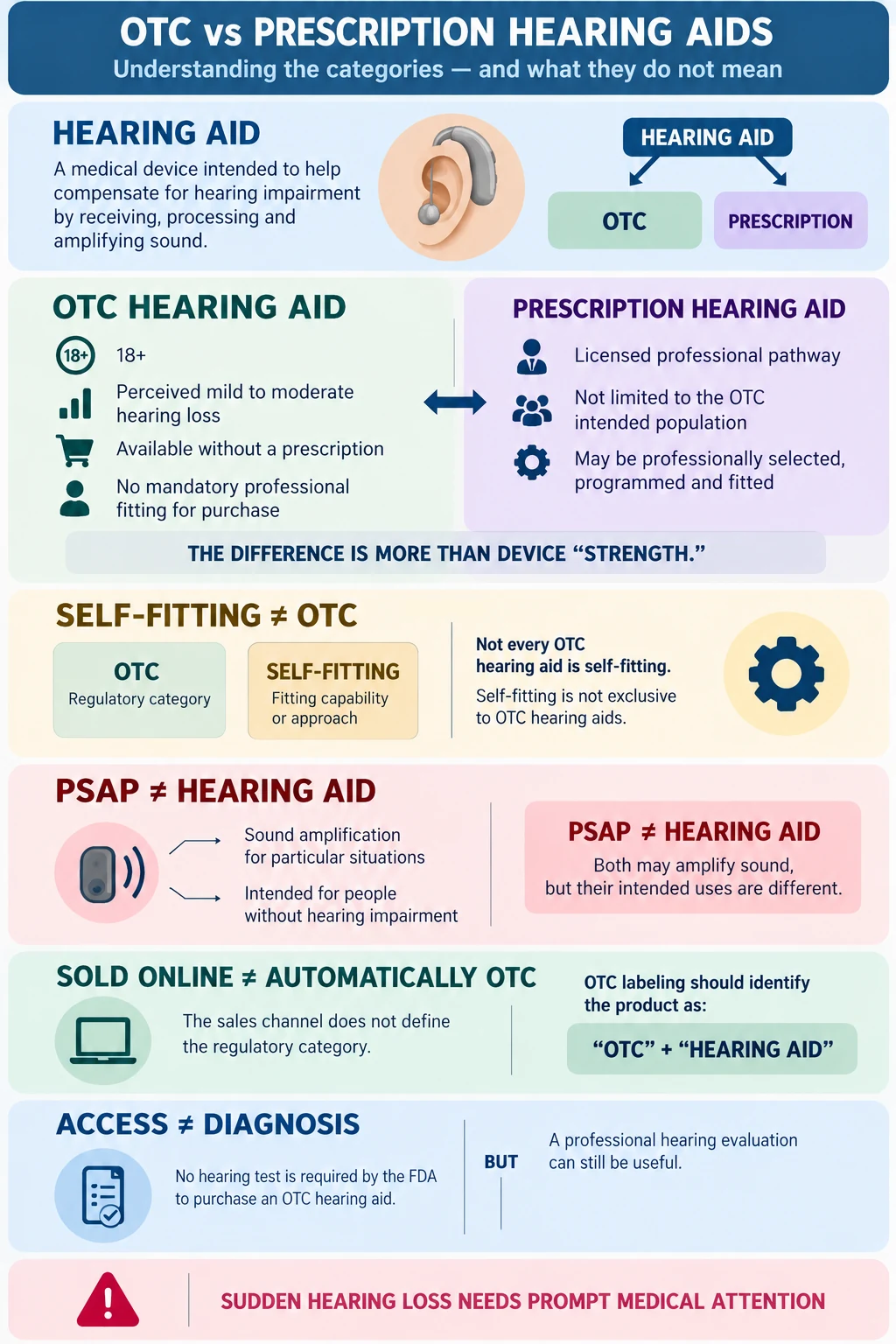
OTC and prescription hearing aids are different regulatory categories. Self-fitting, PSAPs and online sales describe separate concepts and should not be treated as synonyms for OTC.
Are All OTC Hearing Aids Self-Fitting?
No. The terms OTC and self-fitting describe different characteristics.
The FDA identifies both more traditional OTC hearing aids, which may use controls and preset programs, and self-fitting OTC hearing aids that use technology to allow greater customization.
What “Self-Fitting” Means
Self-fitting hearing aids use technology that allows users to customize the device to their hearing needs without professional fitting.
Why Self-Fitting and OTC Are Not Synonyms
Not every OTC hearing aid is a self-fitting device.
Just as importantly, self-fitting is not exclusive to the OTC category. FDA device classifications include both self-fitting OTC hearing aids and self-fitting prescription hearing aids.
OTC describes a regulatory category.
Self-fitting describes a fitting capability or approach.
They should not be treated as interchangeable terms.
What Is a Personal Sound Amplification Product (PSAP)?
A personal sound amplification product, or PSAP, can make sounds louder, but it is not a hearing aid.
PSAPs are intended for people without hearing impairment who want to amplify sounds in particular situations. Examples described by the FDA include activities such as birdwatching or listening to distant sounds.
How a PSAP Differs From a Hearing Aid
The fundamental distinction is intended use.
A hearing aid is intended to compensate for impaired hearing.
A PSAP is intended to amplify sounds in certain environments for a person without hearing impairment.
PSAPs are electronic products, but they are not medical devices like hearing aids.
Why Amplifying Sound Does Not Make a Product a Hearing Aid
Both products may make sound louder. That shared function does not give them the same intended use or regulatory status.
For this reason, a PSAP should not be described as a cheap hearing aid, a weak hearing aid or another type of OTC hearing aid.
The FDA specifically distinguishes PSAPs from hearing aids and states that PSAPs are not alternatives to hearing aids.
Both may amplify sound, but they are intended for different users and purposes.
Does Buying a Hearing Device Online Mean It Is an OTC Hearing Aid?
No. The sales channel alone does not determine whether a product belongs to the FDA's OTC hearing-aid category.
Why the Sales Channel Does Not Define the Product Category
FDA-compliant OTC hearing aids can be purchased online, but they can also be sold in physical stores or through hearing health care professionals.
The fact that a device appears on a website therefore does not, by itself, establish that it is an OTC hearing aid.
Likewise, the word amplifier should not automatically be interpreted as another name for a hearing aid.
What to Look for in OTC Hearing Aid Labeling
The FDA requires specific information on the outside packaging of OTC hearing aids.
Among other information, the words “OTC” and “hearing aid” must be prominently displayed. The labeling also provides information such as whether another device is needed to control the hearing aid and the manufacturer's return policy or absence of one.
Consumers should also be cautious about treating phrases such as “FDA Registered” or “FDA Certified” as proof that a product is an FDA-approved hearing aid. The FDA warns that such statements can be misleading.
Do You Need a Hearing Test Before Buying an OTC Hearing Aid?
For an adult in the OTC hearing-aid category, a hearing test is not an FDA requirement for purchasing the device.
That regulatory fact is different from the question of whether a hearing evaluation may be useful.
What FDA Rules Require — and What They Do Not
Adults 18 and older with perceived mild to moderate hearing loss may purchase OTC hearing aids without a medical examination, prescription or audiological examination.
This is a condition of access to the OTC category. It should not be interpreted as an FDA recommendation that people avoid hearing evaluation.
Why a Professional Hearing Evaluation Can Still Be Useful
The FDA notes that adults may consider having their hearing evaluated to determine the type and amount of hearing loss before obtaining a hearing aid. A hearing health care professional can evaluate hearing and help interpret findings in the context of communication needs and other concerns.
Professional organizations may make additional recommendations. For example, the American Speech-Language-Hearing Association recommends a complete hearing evaluation by an audiologist before purchasing an OTC hearing aid. That is clinical guidance from ASHA, not an FDA requirement for OTC purchase.
For more detail about what hearing evaluations and audiograms measure, see our guide to Hearing Tests and Audiograms.
When Should You Seek Professional or Medical Evaluation?
Direct access to OTC hearing aids does not mean every hearing concern should be managed by purchasing a device.
Some hearing problems warrant further assessment because hearing changes can have causes or associated symptoms that need medical or audiologic attention. The FDA specifically advises medical evaluation when there are medical concerns related to hearing loss.
When Hearing Difficulties Warrant Further Evaluation
FDA guidance and OTC hearing-aid labeling identify warning signs that may warrant medical attention, including ear pain or drainage, dizziness or vertigo, and certain changes in hearing.
These warning signs are not a tool for diagnosing the cause of hearing loss; they indicate when medical evaluation may be appropriate.
Why Sudden Hearing Loss Should Not Wait for an OTC Hearing Aid
A sudden loss or rapid worsening of hearing is different from gradually noticing difficulty hearing.
Hearing aids can be valuable tools for managing hearing loss, but the OTC pathway was created for a defined population and does not replace medical care when warning signs are present.
The central distinction is therefore straightforward: OTC describes a regulated route of access to certain hearing aids; it does not mean that every hearing problem should be self-managed.
Sources
Vitality Product Hub prioritizes major professional and government sources for medical and hearing-health content.
- U.S. Food and Drug Administration (FDA) — OTC Hearing Aids: What You Should Know
- FDA — How to Get Hearing Aids
- FDA — Hearing Aids and Personal Sound Amplification Products: What to Know
- FDA — Other Hearing Devices and Products
- FDA Product Classification — Self-Fitting Air-Conduction Hearing Aid, Over the Counter
- American Speech-Language-Hearing Association (ASHA) — What to Know About OTC Hearing Aids
- NIDCD — Sudden Deafness