Tinnitus is the perception of sound when there is no external sound source producing it. It is often described as ringing in the ears, but tinnitus can sound different from one person to another.
Some people hear buzzing, humming, hissing, roaring, clicking, or other sounds. The sound may be perceived in one ear, both ears, or in the head, and it may be constant or come and go.
Tinnitus can occur alongside hearing loss or after noise exposure. Different conditions and exposures may be associated with tinnitus, and in some people no specific cause is identified.
What Is Tinnitus?
Tinnitus describes sound that is perceived without a corresponding external sound source. Most tinnitus is subjective, meaning that the sound is heard only by the person experiencing it.
Its characteristics can vary from person to person and may also change over time.
What Can Tinnitus Sound Like?
Although “ringing in the ears” is a common description, tinnitus is not limited to ringing.
It may be perceived as buzzing, hissing, humming, roaring, clicking, whistling, or another type of sound. It can be soft or loud, low- or high-pitched, intermittent, or continuous.
The particular sound someone hears does not, by itself, establish what is causing the tinnitus.
Can Tinnitus Affect One Ear, Both Ears, or Seem to Come From the Head?
Yes. Tinnitus may be perceived in one ear, both ears, or in the head.
Where tinnitus seems to be located can be useful information during an evaluation, but its perceived location does not by itself identify an underlying condition.
What Can Cause or Be Associated With Tinnitus?
There is no single explanation for every case of tinnitus.
Tinnitus has been linked with hearing loss, noise exposure, certain medications, earwax blockage or ear infection, and head or neck injury, among other conditions and exposures. In some cases, no known reason is identified.
A list of possible causes or associations therefore cannot determine why a particular person has tinnitus.
Why Tinnitus Does Not Have One Single Cause
Tinnitus can occur in different clinical contexts, and its underlying mechanisms are still being investigated.
How Hearing Loss and Tinnitus Can Be Related
Hearing loss is strongly associated with tinnitus, and the two can occur together. However, they are not the same condition, and some people with hearing loss do not develop tinnitus.
Tinnitus therefore should not be treated as proof that a person has hearing loss, and the perceived severity of tinnitus does not by itself establish the type or degree of hearing loss.
How Noise Exposure and Tinnitus Can Be Related
Tinnitus can occur after exposure to loud sound, and noise exposure is one of the recognized factors associated with tinnitus.
But ringing or another tinnitus sound after noise exposure does not, by itself, diagnose noise-induced hearing loss. Likewise, the absence of tinnitus after noise exposure does not establish that an exposure was harmless.
Assessing noise-related hearing risk requires more than the presence or absence of tinnitus.
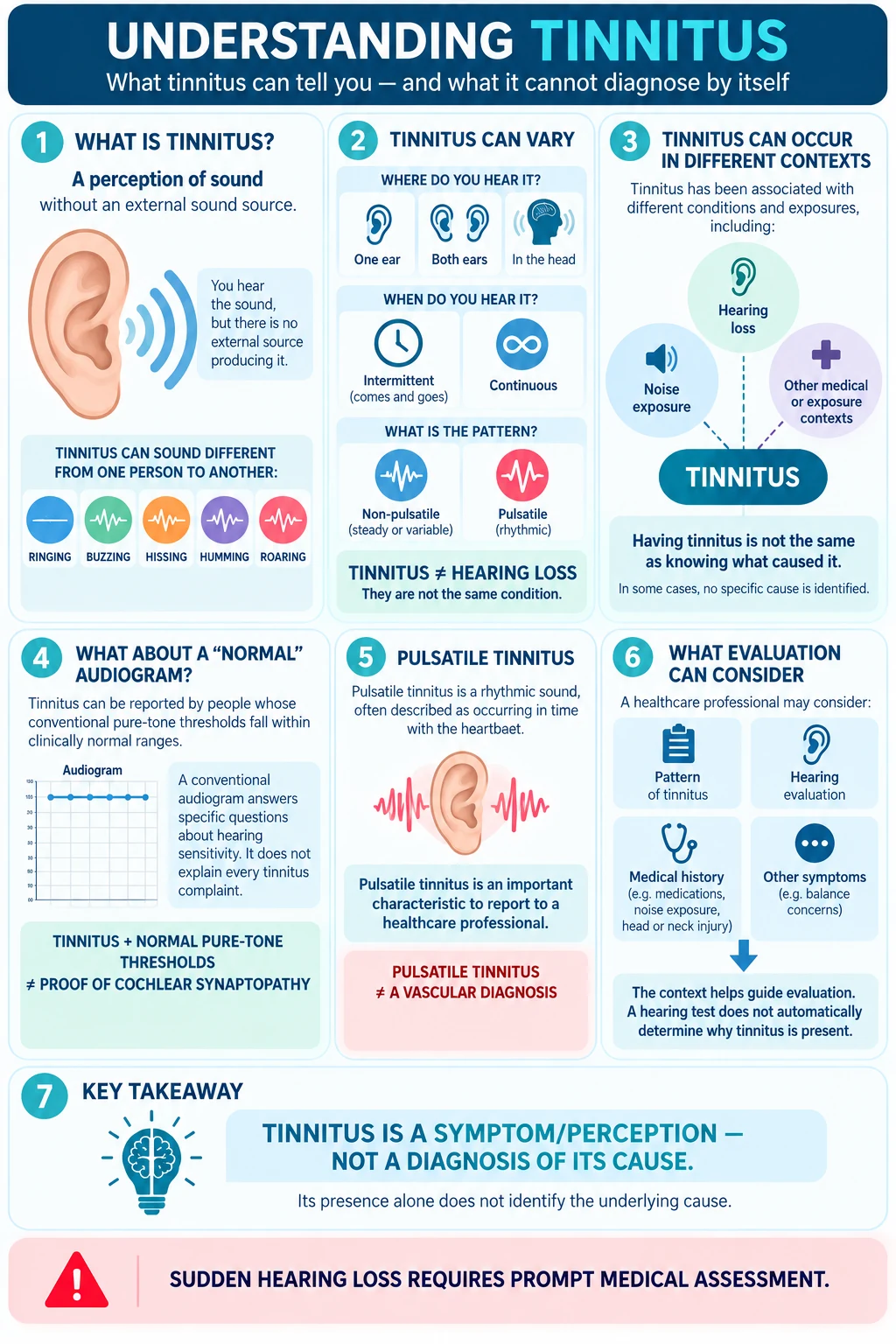
Tinnitus is a symptom or perception. Its pattern can provide useful context during evaluation, but it does not identify the underlying cause by itself.
Can You Have Tinnitus With a Clinically Normal Audiogram?
Tinnitus can be reported by people whose conventional pure-tone thresholds fall within clinically normal ranges.
A conventional audiogram answers particular questions about hearing sensitivity; it does not provide a complete explanation for every tinnitus complaint.
Why Pure-Tone Thresholds Do Not Explain Every Tinnitus Complaint
Pure-tone audiometry measures hearing sensitivity across the frequencies tested. Tinnitus can occur in different auditory and medical contexts.
Clinically normal pure-tone thresholds therefore should not be interpreted as an explanation for why tinnitus is present—or as proof that every aspect of auditory function has been assessed.
Why Tinnitus Does Not Prove “Hidden Hearing Loss” or Cochlear Synaptopathy
Research continues to investigate auditory changes that may not be captured by conventional pure-tone thresholds.
Tinnitus combined with clinically normal conventional thresholds is not sufficient to establish “hidden hearing loss” or cochlear synaptopathy as the cause in an individual.
What Is Pulsatile Tinnitus?
Pulsatile tinnitus is tinnitus with a rhythmic quality, often described as occurring in time with the heartbeat. It is less common than typical subjective non-pulsatile tinnitus.
Pulsatile tinnitus is an important characteristic to report to a healthcare professional.
How Pulsatile Tinnitus Differs From Non-Pulsatile Tinnitus
Most tinnitus is subjective and is heard only by the person experiencing it. Pulsatile tinnitus is distinguished by its rhythmic pattern rather than simply by whether the sound is described as ringing, buzzing, or humming.
A pulsating sound does not tell a person what is causing it.
Why Pulsatile Tinnitus Should Be Medically Evaluated
Clinical guidelines treat pulsatile tinnitus differently from routine non-pulsatile tinnitus because further investigation may be appropriate.
NICE recommends imaging for people with pulsatile tinnitus, with the specific approach depending on its characteristics and findings from clinical and audiological assessment.
The purpose of evaluation is to investigate possible causes—not to assume one from the symptom alone.
How Is Tinnitus Evaluated?
Tinnitus evaluation begins with the context in which the symptom occurs.
A healthcare professional may consider when the tinnitus began, how it sounds, whether it is constant or intermittent, whether it affects one or both ears, relevant noise exposure, medications, medical history, and associated hearing or balance concerns.
The exact evaluation is not identical for every person.
Why the Pattern and History of Tinnitus Matter
Details about tinnitus can help guide what should be evaluated next.
For example, whether tinnitus is pulsatile, persistent, unilateral, associated with hearing changes, or accompanied by other symptoms can be clinically relevant. These characteristics provide context; they do not automatically identify a particular disease.
A medication history, history of noise exposure, and head or neck injury may also be relevant during assessment.
Why Hearing Evaluation May Be Part of the Assessment
Audiologic assessment can help identify hearing loss that occurs alongside tinnitus and provide information about auditory function.
A hearing test does not, however, automatically determine why tinnitus is present.
For a closer look at what conventional hearing tests measure and what an audiogram can and cannot show, see our guide to Hearing Tests and Audiograms.
When Should Tinnitus Be Checked by a Health Professional?
The pattern of tinnitus and any accompanying symptoms can affect what type of evaluation may be appropriate.
The goal is not to use a tinnitus sound as a home diagnostic test. It is to recognize when its characteristics or accompanying symptoms may require professional assessment.
Tinnitus With Sudden or Rapidly Worsening Hearing Loss
A sudden change in hearing should not be treated as ordinary tinnitus or left to a home hearing test to explain.
Persistent Tinnitus in One Ear and Other Features That May Need Evaluation
Persistent tinnitus in one ear is relevant information to report during an assessment. Pulsatile tinnitus and tinnitus associated with asymmetric or unilateral hearing loss can also change the clinical evaluation or referral pathway.
These features do not establish a specific diagnosis.
Pulsatile tinnitus ≠ automatic diagnosis of a vascular condition.
Their importance is that they can help determine whether further evaluation is appropriate.
Does Tinnitus Tell You What Caused It?
No single tinnitus sound, location, pattern, or accompanying hearing-test result can be used by itself to determine the underlying cause.
Tinnitus may occur alongside hearing loss, after noise exposure, with certain medical conditions or medications, or without a clearly identified cause.
Why a Symptom Is Not the Same as a Diagnosis
A symptom tells us what a person is experiencing. A diagnosis attempts to identify the condition or process responsible for that experience.
That distinction is especially important with tinnitus because similar perceptions can occur in different circumstances.
Conclusion
Tinnitus is more than simply “ringing in the ears.” It can take different forms and occur in different clinical contexts.
Hearing loss and noise exposure are important associations, but tinnitus is not the same as hearing loss or noise-induced hearing loss. A clinically normal conventional audiogram does not explain every tinnitus complaint, but tinnitus does not by itself prove “hidden hearing loss” or cochlear synaptopathy either.
Characteristics such as pulsatile tinnitus, persistent unilateral tinnitus, or tinnitus accompanied by hearing changes can be relevant during evaluation.
Sources
Vitality Product Hub prioritizes government, professional clinical guidance, and peer-reviewed research for hearing-health content.