Yes. Diabetes can contribute to erectile dysfunction (ED), especially when it affects the nerves and blood vessels involved in sexual function.
But having diabetes does not mean that every erection problem is caused by diabetes. Erectile dysfunction can have several contributing factors, including cardiovascular disease, medications, hormonal changes, smoking, emotional health and other medical conditions.
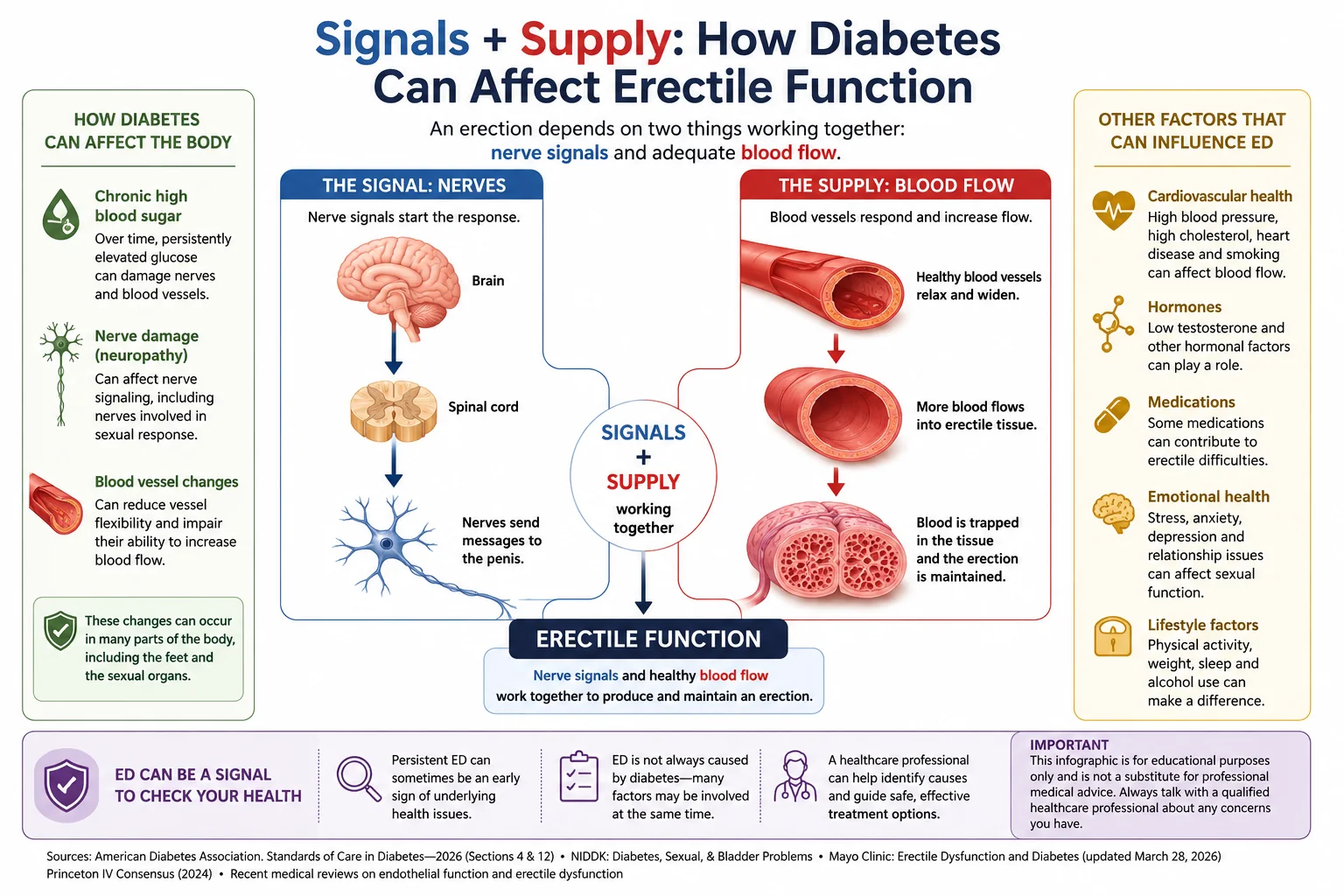
A simple way to understand the diabetes connection is to think about signals and supply.
Nerves help send and coordinate the signals involved in sexual response. Blood vessels then need to respond appropriately so enough blood can reach the erectile tissue.
Diabetes can affect both systems.
This “signals + supply” model is a simplified way to understand a process that also involves hormones, smooth muscle, psychological factors and other biological signals.
Why Is Erectile Dysfunction More Common With Diabetes?
Erectile function depends on several systems working together. Among the most important are the nervous system and the cardiovascular system.
Over time, high blood sugar can damage nerves and blood vessels. When those changes involve pathways needed for sexual function, getting or maintaining an erection may become more difficult.
Not everyone with diabetes develops ED, and individual risk varies. Age, duration of diabetes, cardiovascular health, neuropathy, blood pressure, cholesterol, smoking, depression, hormonal factors and some medications may all be relevant.
Erectile dysfunction can have more than one cause
It can be tempting to see diabetes and ED together and assume that blood glucose explains everything.
Often, the picture is more complicated.
Vascular, neurological, hormonal, medication-related and psychological factors can overlap. Diabetes may be an important part of that picture without necessarily being the only part.
That is one reason persistent ED deserves appropriate evaluation rather than being automatically attributed to diabetes or aging.
How Does Diabetes Affect Erections?
An erection is a coordinated physiological response.
Sexual stimulation activates nerve pathways. Those signals help trigger changes in blood vessels, allowing more blood to enter erectile tissue.
That brings us back to our two-part model:
The signal: nerves need to communicate appropriately.
The supply: blood vessels need to respond and provide adequate blood flow.
Problems on either side can interfere with erectile function.
The signal: nerves help coordinate the response
The nervous system carries information between the brain, spinal cord and different parts of the body. Some of these pathways help coordinate sexual response.
Diabetes can damage nerves over time, a group of complications broadly described as diabetic neuropathy.
The nerves involved in erectile function perform a different job from the sensory nerves that help you feel your feet. Diabetes, however, can affect more than one part of the nervous system.
The supply: blood vessels need to respond
Nerve signals are only part of the process.
Blood vessels also need to relax and allow increased blood flow into erectile tissue. Diabetes can affect vascular health and make this response less effective.
That is why diabetic ED cannot always be described accurately as only a nerve problem or only a circulation problem.
Why nerves and blood vessels matter together
The nerve signal helps initiate and coordinate the response. Blood vessels then need to react appropriately.
Diabetes can interfere with different parts of this pathway, which helps explain why erectile dysfunction associated with diabetes can involve both neurological and vascular factors.
What Does High Blood Sugar Have to Do With It?
Persistently elevated blood glucose can contribute over time to complications involving nerves and blood vessels. Those same systems are important for normal erectile function.
This connection is about changes that can develop over time—not about assuming that one unusually high glucose reading caused an episode of ED.
This usually isn't about a single high reading
Diabetes-related complications develop in a much broader context that includes glucose management, duration of diabetes and individual health factors.
A single blood glucose result therefore cannot establish why someone is experiencing erectile difficulties.
The underlying cause needs to be considered in the context of the whole person.
Can Diabetic Neuropathy Contribute to Erectile Dysfunction?
Yes. But this is where an important distinction becomes useful.
When people hear “diabetic neuropathy,” they often think about burning, tingling or numbness in the feet. Those symptoms are commonly associated with peripheral nerve damage.
Diabetes can affect other parts of the nervous system as well.
Peripheral and autonomic nerves have different roles
The autonomic nervous system helps regulate body functions that occur largely without conscious control.
Diabetic autonomic neuropathy can affect several body systems, and erectile dysfunction is one of its recognized genitourinary manifestations.
This is different from losing sensation in the feet, even though diabetes can contribute to both problems.
The shared connection is the nervous system—not that one symptom causes the other.
Does Diabetes Affect Blood Flow?
The vascular side of the equation matters just as much.
An erection requires blood vessels to respond to signals and increase blood flow into erectile tissue.
Diabetes is associated with vascular changes that may interfere with that response. Cardiovascular and metabolic factors frequently overlap as well, making the underlying picture more complex than blood glucose alone.
For a broader look at the vascular side of diabetes, see how diabetes can affect circulation and blood flow throughout the body.
Blood vessel health and erectile function
The inner lining of blood vessels—the endothelium—helps regulate vessel relaxation.
Nitric oxide is one of the signals involved in that response. When endothelial and vascular function are impaired, the normal increase in blood flow needed for an erection can become more difficult.
For our purposes, the important idea is simple: healthy erectile function requires blood vessels that can respond appropriately when nerve signals arrive.
Why ED may deserve broader health attention
Erectile dysfunction and cardiovascular disease share several risk factors.
Persistent ED can be an appropriate reason to review cardiovascular and metabolic health with a healthcare professional. That does not mean that someone with ED necessarily has heart disease.
Blood pressure, cholesterol, smoking, medications, diabetes and overall cardiovascular health may all be relevant.
Can Erectile Dysfunction Be an Early Sign of Diabetes?
Sometimes erectile difficulties can appear before diabetes has been diagnosed.
But ED is not specific to diabetes and cannot be used by itself to diagnose it.
If someone is concerned about diabetes, appropriate medical testing—not erectile symptoms alone—is what establishes a diagnosis.
ED alone cannot tell you the cause
Two people experiencing similar erection problems can have very different underlying factors.
For one person, vascular health may be important. For another, medications or hormonal factors may contribute. Neurological and psychological factors can also play a role, and several contributors can occur together.
The symptom tells us that something deserves attention. It does not tell us the cause by itself.
Can Managing Diabetes Help Erectile Function?
Managing diabetes is important for protecting overall nerve, vascular and cardiovascular health.
But improving blood glucose should not be presented as a guaranteed way to reverse ED. The outcome depends on the underlying causes, how long the problem has been present and the person's broader health.
Blood glucose is only part of the picture
Factors relevant to erectile health may include:
- blood glucose management
- blood pressure
- cholesterol
- cardiovascular health
- smoking
- physical activity
- body weight
- medications
- hormonal factors
- emotional and psychological health
These factors are one reason treatment needs to be individualized.
When Should You Talk to a Healthcare Professional?
Occasional difficulty getting or maintaining an erection can happen for many reasons.
When the problem becomes persistent or recurrent, represents a noticeable change, or is causing concern, it is reasonable to discuss it with a healthcare professional.
For someone with diabetes, that conversation can also provide an opportunity to review nerve health, cardiovascular risk factors, medications and other possible contributors.
Why identifying the cause matters
ED is a symptom—not a diagnosis of its cause.
Medical evaluation may consider cardiovascular and metabolic health, medications, neurological factors, hormonal issues and emotional or psychological contributors.
Identifying likely causes helps guide appropriate care.
Don't assume diabetes is the only explanation
Having diabetes and ED at the same time does not prove that diabetes is solely responsible.
Another factor—or several factors together—may be involved.
That is why persistent ED is worth approaching as a health concern in its own right rather than simply accepting it as an inevitable consequence of diabetes or getting older.
The Bigger Picture: Nerves, Blood Vessels and Diabetes
The feet and erectile function may seem completely unrelated.
But both depend, in different ways, on healthy nerves and blood vessels.
In the feet, diabetes-related changes can affect sensation, circulation, injury awareness and healing. Our guide to diabetes-related foot problems explores those effects in detail.
Erectile function involves different tissues and physiological responses, yet nerve signaling and vascular function are again important.
This does not mean that someone with burning feet, numbness or another foot symptom will develop erectile dysfunction. Foot symptoms do not cause or predict ED simply because both can occur in diabetes.
The deeper connection is biological: diabetes can affect nerves and blood vessels in different parts of the body, producing very different problems depending on which systems are involved.
That broader perspective helps connect diabetes complications without treating every symptom as if it had the same cause.
Sources & Medical References
This article was developed using current guidance and established medical references.
- American Diabetes Association — Standards of Care in Diabetes—2026: Comprehensive Medical Evaluation and Assessment of Comorbidities
- American Diabetes Association — Standards of Care in Diabetes—2026: Retinopathy, Neuropathy, and Foot Care
- NIDDK — Diabetes, Sexual, & Bladder Problems
- Mayo Clinic — Erectile Dysfunction and Diabetes: Take Control Today
Published: August 30, 2026 · Last reviewed: August 30, 2026