A change in tooth color can be easy to notice but difficult to interpret.
Teeth may appear more yellow, brown, gray, white, or simply different from the teeth around them. Sometimes the change affects several teeth. In other situations, one tooth becomes noticeably darker than the others.
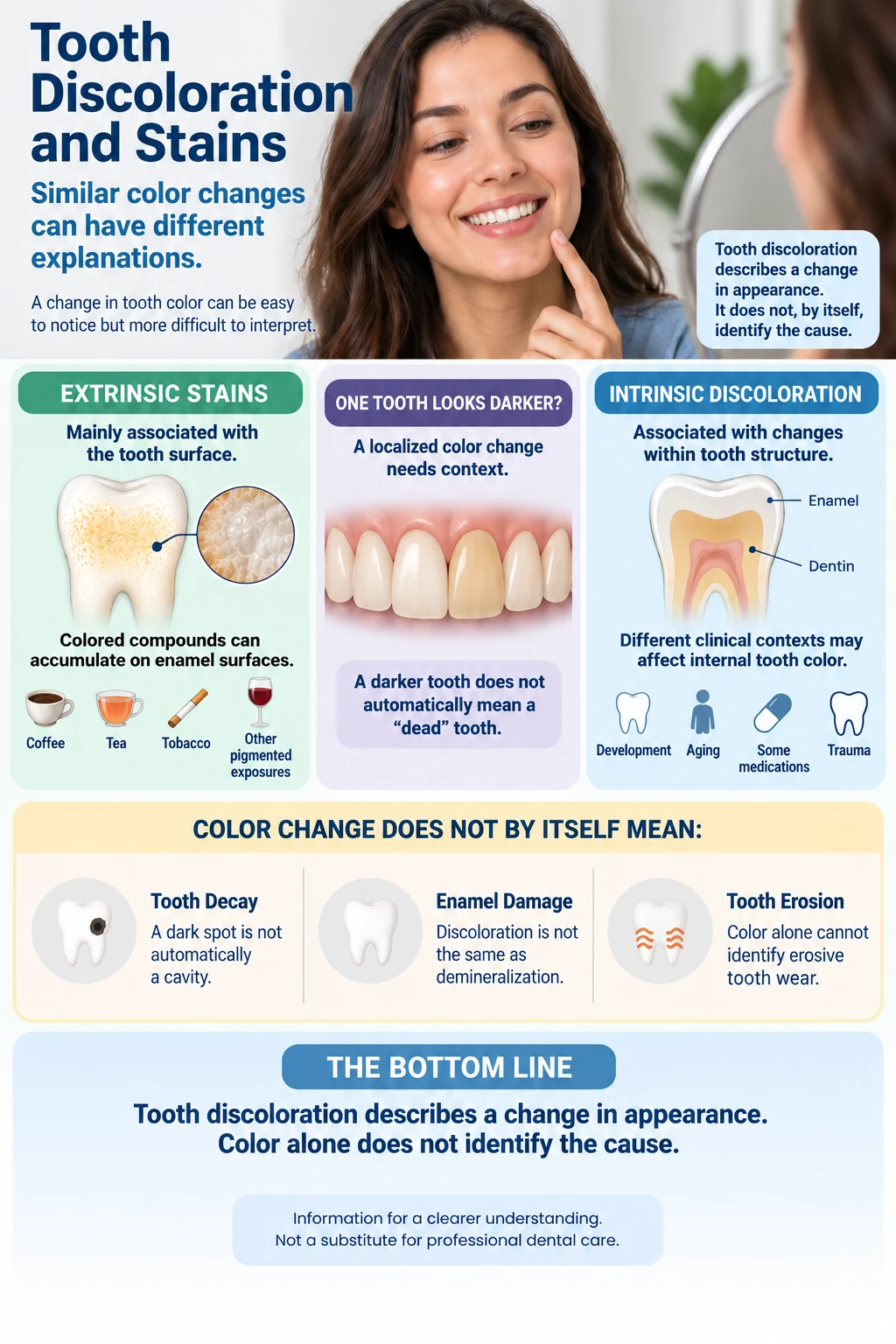
These changes are often described as tooth discoloration, but that term does not identify a single cause. Dental professionals commonly distinguish between discoloration related mainly to substances on the outside of the tooth and discoloration that involves the tooth structure itself. Some changes can involve elements of both.
That distinction matters because a visible stain, an internal color change, tooth decay, enamel changes, and tooth erosion are not interchangeable findings.
The most useful starting point is therefore not simply what color a tooth has become, but what kind of change has occurred and what else may be happening around it.
What Is Tooth Discoloration?
Tooth discoloration is a broad term for changes in the color or appearance of teeth.
Some discoloration develops gradually across many teeth. Other changes may be localized to one tooth or one area. Appearance can also vary in intensity and distribution.
For that reason, tooth discoloration is better understood as a visible finding that may have different explanations, rather than as one condition with one cause.
What Does a Change in Tooth Color Mean?
A change in color means that something about the way a tooth looks has changed. It does not explain why on its own.
Pigmented substances can accumulate on tooth surfaces. Changes can also occur within dental tissues. Age, developmental factors, certain medications, trauma, dental disease, and other clinical circumstances may enter the picture.
These possibilities should not be treated as a checklist for identifying the cause at home. Different processes can produce changes that look similar, while the same general process may not always produce an identical appearance.
Why Tooth Discoloration Is a Finding, Not a Diagnosis
Color is one piece of information.
A brown area is not synonymous with tooth decay. A yellow appearance does not establish enamel damage. A gray tooth, by itself, does not show what is happening inside the tooth.
Pattern, location, timing, dental history, accompanying symptoms, and clinical examination can all change how a color alteration is interpreted.
What Is the Difference Between Extrinsic and Intrinsic Tooth Discoloration?
One useful way to understand tooth discoloration is to distinguish between extrinsic and intrinsic changes.
The distinction relates broadly to where the discoloration is occurring, although real-world cases are not always neatly separated. Extrinsic and intrinsic influences can coexist.
What Extrinsic Tooth Stains Mean
Extrinsic stains commonly involve colored compounds that accumulate on the enamel surface.
Foods, beverages, tobacco, and other exposures can contribute to this type of staining.
Because these stains are associated primarily with the external surface, they differ from color changes arising within the tooth structure.
That distinction does not mean every visible stain can be reliably classified simply by looking at it.
What Intrinsic Tooth Discoloration Means
Intrinsic discoloration involves changes associated with the internal structure of the tooth rather than only material deposited on its surface.
Developmental influences, aging, certain medications, trauma, and changes involving the dental pulp are among the contexts that may be considered during evaluation.
Importantly, intrinsic discoloration is a category, not a diagnosis.
Recognizing that a change may be internal does not establish the biological process responsible for it.
What Can Cause Extrinsic Tooth Stains?
Everyday exposures can contribute to surface staining.
Coffee and tea are familiar examples. Tobacco and strongly pigmented foods or beverages can also contribute to external discoloration.
How visible these stains become can vary considerably.
Coffee, Tea, Tobacco, and Other Pigmented Exposures
Pigmented compounds can interact with deposits and surfaces in the mouth, contributing over time to visible staining.
This helps explain why certain dietary or lifestyle exposures are commonly discussed in relation to extrinsic discoloration.
The presence of one of these exposures, however, does not establish what caused an individual tooth change.
Why an Exposure Does Not Prove What Caused an Individual Stain
A person who drinks coffee can still develop tooth discoloration for reasons unrelated to coffee.
Likewise, noticing discoloration after an exposure does not show that the exposure is responsible for every aspect of the change.
Association and timing can provide useful context, but they do not replace evaluation of the tooth itself.
What Can Cause Intrinsic Tooth Discoloration?
Intrinsic discoloration has a broad range of possible contexts because the change involves the tooth structure rather than only an external deposit.
Some intrinsic changes develop while teeth are forming. Others appear later.
Development, Aging, Medications, and Other Clinical Contexts
Changes in tooth appearance can occur with aging as enamel and dentin change over time.
Developmental disturbances can influence tooth color. Fluorosis can produce enamel changes under particular exposure conditions during tooth development, while certain medications, including tetracycline-class antibiotics under specific developmental circumstances, have long been associated with intrinsic discoloration.
Trauma and changes involving the dental pulp may also be considered when a tooth changes color.
These are possible clinical contexts, not explanations that can be assigned from color alone.
Why Intrinsic Discoloration Can Have Different Explanations
Two teeth that look similar do not necessarily have the same history.
Conversely, teeth affected by the same general process may not show exactly the same appearance.
This is one reason dental discoloration is interpreted using more than shade alone. Age, timing, distribution, previous dental treatment, trauma history, symptoms, and examination findings may all matter.
Why Can One Tooth Become Darker Than the Others?
A single tooth becoming darker can attract more attention than gradual changes across the entire dentition.
It also creates an important distinction: localized discoloration can have a different clinical context from generalized staining.
Why a Localized Color Change Deserves Context
Previous trauma is one factor that may be relevant when an individual tooth changes color. Changes involving the pulp and previous dental treatment can also enter the clinical assessment.
These possibilities cannot be reliably separated simply by comparing the tooth with its neighbors in a mirror.
The history of the tooth matters.
Why a Dark Tooth Does Not Automatically Mean the Tooth Is “Dead”
The common shortcut “dark tooth = dead tooth” is too simplistic.
Changes involving the pulp can affect tooth color, but discoloration alone does not establish pulp necrosis or mean that a tooth is “dead.”
A darker tooth therefore needs to be interpreted in context rather than assigned a diagnosis from appearance.
Does Tooth Discoloration Mean Tooth Decay?
No single tooth color is synonymous with tooth decay.
Caries can alter the appearance of a tooth, but discoloration occurs in other contexts as well.
Why a Dark Spot Is Not Automatically a Cavity
A dark area may raise questions about decay, but visual color alone cannot establish whether a caries lesion is present.
Tooth decay is a dynamic disease process, not simply a color.
A cavity is one possible structural result of that process, and a dark spot is not automatically a cavity.
Our guide to tooth decay and cavities explains that process in greater detail.
Why Tooth Color Alone Cannot Diagnose Decay
Dental professionals interpret suspected caries using clinical context and examination rather than relying on color as an isolated diagnostic rule.
That distinction helps avoid two opposite assumptions: that every dark area is decay, or that an area must look dark to be clinically important.
Does Tooth Discoloration Mean the Enamel Is Damaged?
Not necessarily.
Appearance and structural integrity can be related in some circumstances, but they are not the same concept.
A change in tooth color does not by itself establish that enamel has been lost, weakened, demineralized, or eroded.
Why Color Change Is Different From Demineralization
Demineralization describes mineral loss from dental hard tissue.
Discoloration describes a change in appearance.
Those concepts can sometimes intersect, but one should not be substituted for the other.
Our guide to tooth enamel demineralization and remineralization explains the mineral process separately.
Why Discoloration Does Not Automatically Mean Tooth Erosion
Tooth erosion involves acid-related chemical loss of mineralized tooth structure and belongs to the broader clinical territory of erosive tooth wear.
A difference in tooth color does not establish that erosion has occurred.
Likewise, appearance alone cannot determine whether structural tooth wear is present or what process produced it.
Our guide to tooth erosion and erosive tooth wear explores that distinction in detail.
Can Tooth Color Tell You What Caused the Discoloration?
Color can contribute to a clinical assessment, but it cannot function as a diagnostic code.
There is no reliable home rule in which yellow always means one process, brown another, gray another, and white another.
Why Yellow, Brown, Gray, or White Changes Are Not Diagnoses
Dental discoloration can vary in color, distribution, location, intensity, and underlying explanation.
Those variables overlap too much for a shade chart to reliably identify the cause of an individual change.
Even a familiar-looking pattern needs context.
Why Pattern, Location, History, and Dental Examination Matter
A dental evaluation can consider questions that color alone cannot answer.
Is one tooth affected or many? Did the change appear suddenly or gradually? Is there a history of trauma or dental treatment? Are there accompanying symptoms? Does the alteration appear superficial or involve the tooth structure?
These are pieces of clinical context, not a home diagnostic algorithm.
Their value comes from being interpreted together.
Can Whitening Tell You What Type of Discoloration You Have?
Different types of discoloration may respond differently to whitening or stain-removal approaches.
That does not make whitening a diagnostic test.
Why Different Discolorations May Respond Differently
Different whitening approaches do not act on every type of discoloration in the same way.
Some products work primarily by reducing extrinsic surface stains, while bleaching approaches can also alter intrinsic tooth color. The type and cause of the discoloration therefore matter when appropriate options are considered.
This distinction should not be turned into a home experiment for determining what caused a color change.
Why Whitening Response Is Not a Diagnostic Test
A stain becoming lighter does not prove exactly what caused it.
A color change that does not respond as expected also does not establish a particular diagnosis.
For this reason, response to whitening should not be used to decide whether a tooth is healthy, decayed, eroded, non-vital, or affected by another condition.
How Is Tooth Discoloration Evaluated?
Evaluation begins by treating discoloration as one finding within a broader dental picture.
The goal is not merely to name the color but to understand the pattern and its possible explanation.
What Dental and Health History Can Contribute
A dental professional may consider when the discoloration appeared, whether one or several teeth are affected, previous trauma or dental procedures, relevant exposures, medications, developmental history, and other clinical information.
Which details matter depends on the individual situation.
Why Examination Matters More Than Color Alone
Clinical examination allows tooth color to be interpreted alongside the condition of surrounding dental structures and other findings.
Additional assessment may be appropriate in some situations, particularly when the color change is localized or when other dental findings or symptoms are present.
No photograph, shade description, or mirror inspection can provide that entire context.
When Should a Change in Tooth Color Be Professionally Evaluated?
Professional evaluation can help clarify a new or unexplained change in tooth color when its cause is uncertain.
Evaluation can be particularly useful when one tooth changes noticeably compared with neighboring teeth, when discoloration follows dental trauma, when the change occurs alongside pain or other symptoms, or when there is concern about decay or structural change.
These features do not identify a diagnosis by themselves. They describe situations in which understanding the reason for the color change may matter more than simply trying to alter its appearance.
The Bottom Line
Tooth discoloration can occur for many reasons.
Extrinsic stains are primarily associated with material on the external tooth surface, while intrinsic discoloration involves changes associated with the tooth structure. Some situations may involve both.
A darker area is not automatically a cavity. A color change does not establish enamel damage or tooth erosion. And one darker tooth does not, by itself, mean that the tooth is “dead.”
Different colors and patterns can provide useful information, but they should not be converted into home diagnostic rules.
Sources & References
- American Dental Association — Whitening
- PubMed PMID 10825865 — The mechanisms of tooth staining and discoloration
- PubMed PMID 16262034 — Tooth discolouration and staining: a review of the literature
- PubMed PMID 20630191 — Evidence relevant to visual assessment of caries lesions
Last updated: September 18, 2026.