Fluoride and Oral Health: What Does Fluoride Actually Do for Your Teeth?
Fluoride has a well-established role in preventing dental caries, but familiar phrases such as “strengthens enamel” can make its effects sound simpler than they actually are.
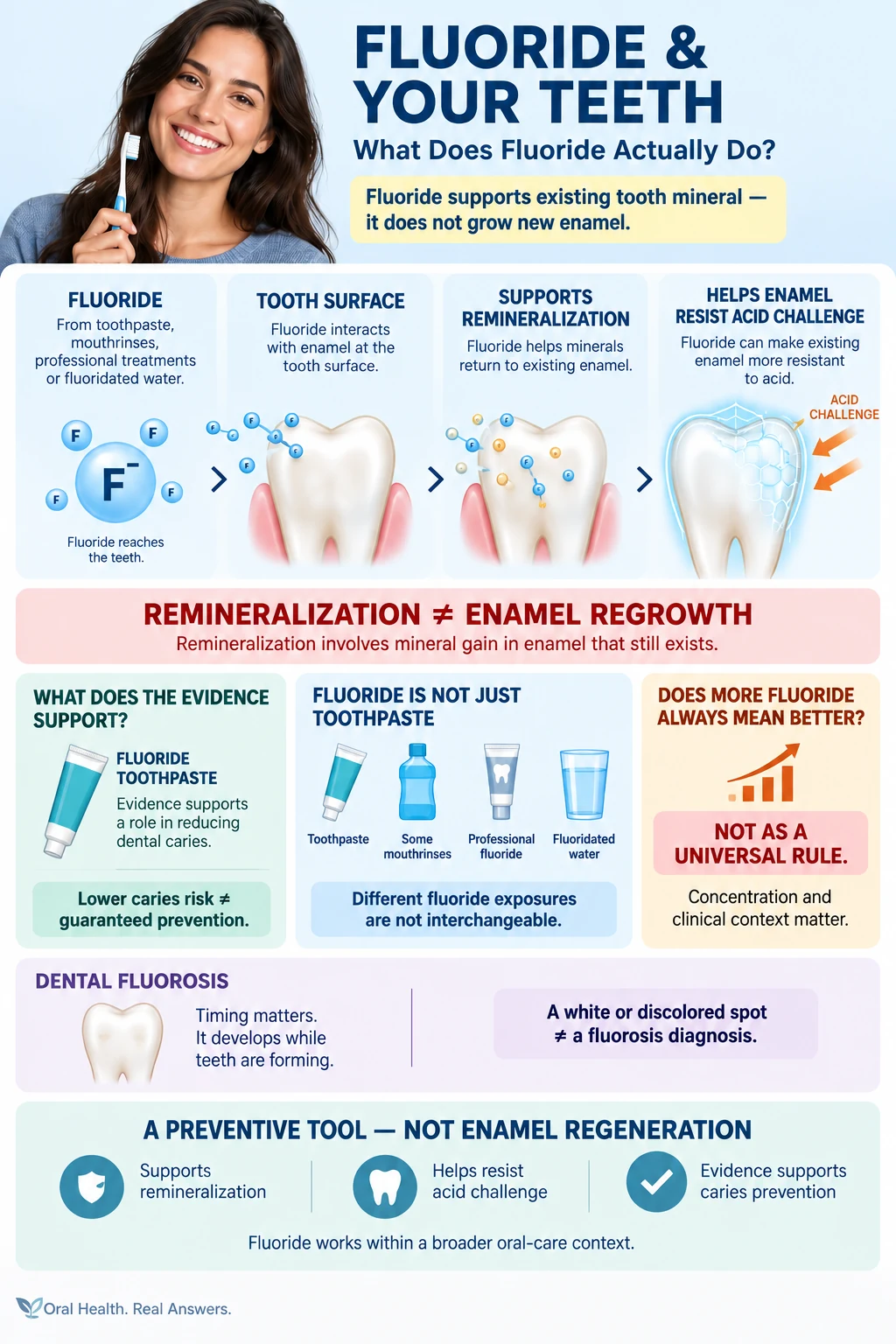
Fluoride appears in toothpaste, some mouthrinses, professional dental products, and community water supplies. It does not grow new enamel, and exposure to fluoride does not guarantee that tooth decay will never occur.
Its role is better understood as part of the mineral processes taking place at the tooth surface and as one component of caries prevention. Understanding what fluoride actually does — and what it does not do — helps separate established evidence from exaggerated claims.
What Is Fluoride?
Fluoride is the ionic form of fluorine, an element that occurs naturally in the environment. It can be present in water, soil, rocks, foods, and other environmental sources.
In dentistry, fluoride is important because of the way it interacts with mineralized tooth structures and the processes involved in dental caries. Its role in caries prevention has been studied for decades, and fluoride can reach the teeth through different routes.
Where Does Fluoride Come From?
Some fluoride occurs naturally in water. Fluoride may also be added to community water supplies or included in oral-care products such as toothpaste and some mouthrinses. Dental professionals can also use fluoride-containing products in clinical care.
These sources are not interchangeable. They can differ in how fluoride is delivered, its concentration, how frequently exposure occurs, and the context in which it is used.
How Can Teeth Be Exposed to Fluoride?
Fluoride can reach the teeth through topical exposure, such as toothpaste and professional products, and through systemic exposure, such as fluoridated water.
These routes are not identical, and the evidence for one fluoride intervention should not automatically be transferred to another.
The distinction matters because saying that something “contains fluoride” does not tell us everything about how that exposure occurs or what evidence applies to it.
What Does Fluoride Actually Do to Tooth Enamel?
Tooth enamel is a mineralized tissue that is repeatedly exposed to changing conditions in the mouth.
When conditions favor mineral loss, demineralization can occur. Under more favorable conditions, minerals can return to existing enamel through remineralization.
At the tooth surface, fluoride can support remineralization and help make existing enamel more resistant to acid challenge.
Fluoride, Demineralization, and Remineralization
The important point is that fluoride participates in a mineral process involving existing tooth structure.
It does not need to create a new layer of enamel from scratch to have a meaningful role in caries prevention.
Our guide to tooth enamel demineralization and remineralization explains the mineral-loss and mineral-gain process in greater detail.
Why Remineralization Is Not the Same as Regrowing Enamel
The word “remineralization” can easily be misunderstood.
Remineralization involves mineral gain within enamel that still exists. Regeneration would mean replacing enamel tissue that has already been structurally lost.
Those are different biological events.
How Does Fluoride Help Prevent Tooth Decay?
Fluoride's role in oral health is supported not only by what is known about its interaction with tooth mineral but also by clinical evidence involving dental caries.
Fluoride toothpaste has been extensively studied, and systematic-review evidence supports its use for reducing caries compared with non-fluoride toothpaste.
That does not mean fluoride works in isolation. Dental caries is a dynamic, multifactorial disease process, and fluoride represents one part of a broader preventive context.
What the Evidence Shows About Fluoride Toothpaste
A Cochrane review including 96 studies found that fluoride toothpaste at certain studied concentrations reduced new caries compared with non-fluoride toothpaste. Some comparisons also found differences between fluoride concentrations, while evidence for several other concentration comparisons remained uncertain.
These findings support the preventive role of fluoride toothpaste; they are not an individualized instruction to choose a particular fluoride concentration.
Why Lower Caries Risk Does Not Mean Guaranteed Prevention
Evidence of lower caries development across study groups describes a change in risk. It does not predict with certainty what will happen to every individual tooth or every person.
Fluoride can be part of caries prevention while other biological and behavioral factors continue to matter.
For a closer look at the disease process itself, our guide to tooth decay and cavities explains why early tooth decay, progression, and cavity formation are related but not interchangeable concepts.
Is Fluoride Toothpaste the Only Source of Fluoride?
No.
Toothpaste is one familiar form of fluoride exposure in oral care, but fluoride can be delivered in several ways.
Fluoride interventions differ in product type, concentration, method of delivery, and clinical context, so evidence for one intervention should not automatically be applied to another.
Toothpaste and Mouthrinse
Fluoride toothpaste provides topical fluoride during brushing and has substantial evidence supporting its role in caries prevention.
Some mouthrinses also contain fluoride. However, evidence about fluoride toothpaste should not automatically be transferred to a mouthrinse, or vice versa. They are different delivery methods and have been evaluated separately.
Professional Fluoride Treatments
Dental professionals can apply topical fluoride products such as varnishes and gels.
Clinical guidance for professional and prescription-strength topical fluorides considers factors including caries risk and the type of product being used.
Professional fluoride products therefore should not simply be interpreted as “stronger toothpaste,” nor does their existence mean that everyone requires the same fluoride intervention.
Fluoridated Water as Another Source of Exposure
Community water fluoridation is another route through which people may be exposed to fluoride.
Water exposure differs from brushing with toothpaste or receiving a professional topical application. The existence of several routes of exposure is another reason that “fluoride” should not be treated as though it describes a single product or intervention.
This article focuses on fluoride's role in oral health rather than the broader public-health questions surrounding community water fluoridation.
Does More Fluoride Always Mean Better Protection?
Not as a universal rule.
Studies comparing fluoride toothpastes indicate that concentration can influence caries prevention. However, the evidence is not equally certain for every concentration comparison, population, or age group.
Some comparisons have favored higher fluoride concentrations, while other comparisons have produced similar or less certain results.
Why Concentration and Context Matter
Fluoride concentration is only one part of the picture.
Age, tooth development, caries risk, type of product, method of use, and whether a product is intended for routine, professional, or prescription use can affect how fluoride exposure is evaluated.
This is especially relevant during childhood because excessive fluoride ingestion while teeth are developing can contribute to dental fluorosis.
For that reason, evidence showing differences among fluoride concentrations should not be turned into a universal instruction to select the highest concentration available.
Why Professional and High-Concentration Fluoride Requires Individual Context
Professional and prescription-strength fluoride products occupy a different clinical context from ordinary over-the-counter toothpaste.
Guidance for these interventions can incorporate caries risk, the type of fluoride product, and professional judgment rather than treating higher-concentration fluoride as a universal requirement.
The existence of a higher-concentration product therefore does not establish that it is the appropriate choice for a particular person.
What Is Dental Fluorosis?
Dental fluorosis is a change in the appearance of enamel associated with excessive fluoride exposure while teeth are developing.
It can appear as white flecks, spots, or lines, with more pronounced enamel changes possible in more severe cases. In the United States, the CDC describes dental fluorosis as mostly mild and cosmetic.
Why Timing During Tooth Development Matters
Timing is central to understanding fluorosis.
The CDC explains that once the enamel of permanent teeth has finished developing, older children, teenagers, and adults do not newly develop dental fluorosis in the way it occurs during tooth formation.
That distinguishes fluorosis from tooth discoloration or surface changes that may become noticeable later in life.
Why a White or Discolored Spot Is Not Automatically Fluorosis
A tooth's appearance alone does not establish why its color or surface has changed.
White areas and discoloration can have different explanations, and visual inspection alone cannot reliably establish that fluorosis is the cause.
Our guide to tooth discoloration and stains explains why tooth color alone is not a diagnosis.
Can Fluoride Repair a Cavity or Regrow Lost Enamel?
These ideas need to be separated.
Fluoride can support remineralization of existing enamel and has an established role in caries prevention.
That does not mean fluoride can universally repair an established structural cavity or regenerate enamel that has been lost.
An established cavity is not the same thing as early mineral loss, just as remineralizing existing enamel is not equivalent to replacing enamel tissue that is no longer there.
What Are the Most Important Limits to Understand About Fluoride?
Fluoride has an established role in caries prevention, but evidence for one fluoride intervention should not automatically be applied to every other fluoride-containing product. Likewise, evidence that concentration can influence an outcome does not mean that the highest concentration is the appropriate choice for every person.
The same boundaries apply to the language used to describe its effects: caries-risk reduction is not guaranteed prevention, remineralization is not enamel regeneration, and dental fluorosis is not a diagnosis that can be made from any white or discolored area on a tooth.
These limits do not diminish fluoride's role in oral health. They define that role more accurately.
What Is the Practical Takeaway About Fluoride and Oral Health?
Fluoride has a well-established place in the prevention of dental caries.
At the tooth surface, fluoride can support remineralization and help make existing enamel more resistant to acid challenge. Clinical evidence also supports fluoride toothpaste for reducing caries compared with non-fluoride toothpaste.
But fluoride is not a mechanism for growing new enamel, it does not make every fluoride-containing product interchangeable, and its preventive benefit does not guarantee that tooth decay will never occur.
The clearest way to understand fluoride is therefore neither as a miracle ingredient nor as an isolated solution.
It is a well-studied preventive tool whose effects need to be interpreted according to how fluoride is delivered, the context in which it is used, and the outcome being considered.
Sources
- American Dental Association. Fluoride: Topical and Systemic Supplements.
- Cochrane. Fluoride toothpastes of different strengths for preventing tooth decay.
- American Dental Association. Topical Fluoride Clinical Practice Guideline.
- Centers for Disease Control and Prevention. About Dental Fluorosis.