Sugar-Free Chewing Gum and Oral Health: What Does the Evidence Actually Show?
Sugar-free chewing gum is often associated with oral health, but the science behind that connection is more nuanced than the words “sugar-free” may suggest.
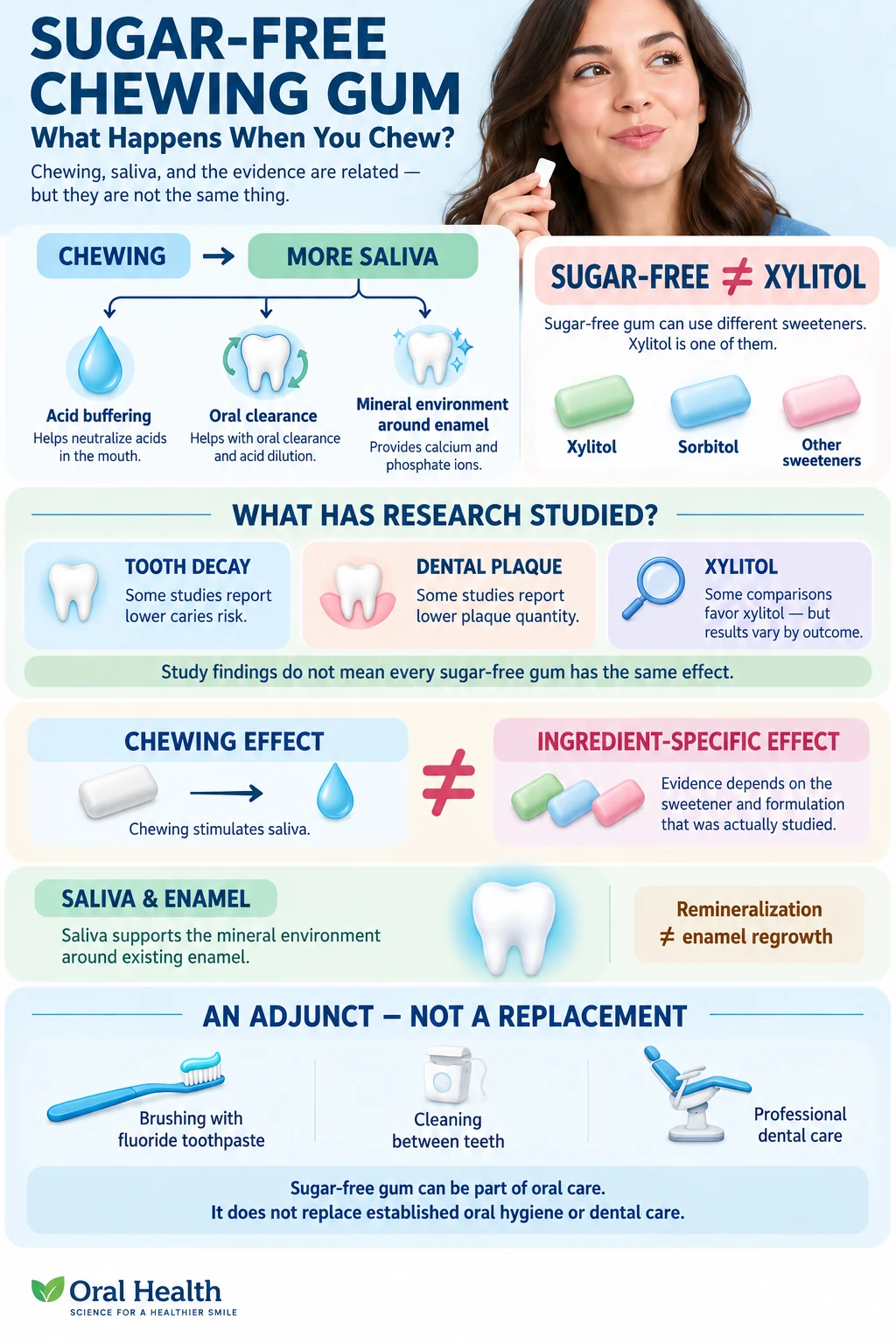
Part of the effect comes from chewing itself, which stimulates saliva. Other questions involve the ingredients used in place of sugar, including sweeteners such as xylitol and sorbitol. Research has also examined outcomes such as dental caries and plaque, although findings vary across formulations and studies.
Understanding those differences helps clarify what sugar-free gum may contribute to oral health — and what the evidence does not establish.
What Is Sugar-Free Chewing Gum?
Sugar-free chewing gum is formulated without the amounts of sugars found in conventional sugar-containing gum. Instead, different sweeteners may be used.
Sugar-free gums use sweeteners that differ from the fermentable sugars found in conventional sugar-containing gum. They may contain ingredients such as xylitol, sorbitol, mannitol, maltitol, erythritol, or combinations of sweeteners.
However, the term “sugar-free” does not mean that every gum has the same formulation or has demonstrated the same oral-health effects.
What Does “Sugar-Free” Actually Mean?
“Sugar-free” describes a characteristic of the product. It is not, by itself, evidence of a particular dental benefit.
Under U.S. labeling rules, a food can be labeled sugar-free when it contains less than 0.5 grams of sugars per serving. Two chewing gums can therefore carry the same sugar-free label while using different ingredients.
Is Sugar-Free Gum the Same as Xylitol Gum?
No. Xylitol is one possible sweetener used in sugar-free gum.
Other formulations may use sorbitol, mannitol, maltitol, erythritol, other sweeteners, or combinations of ingredients. That means findings from a study specifically evaluating xylitol gum should not automatically be applied to every product labeled sugar-free.
What Happens in Your Mouth When You Chew Gum?
One of the clearest effects of chewing gum begins not with a particular sweetener, but with the act of chewing.
Chewing provides mechanical stimulation, while taste can add sensory stimulation. Together, these can increase salivary flow. Saliva contributes to normal processes in the mouth, including acid clearance and buffering.
How Chewing Stimulates Saliva
Research summarized by the American Dental Association shows that even chewing an unsweetened, unflavored gum base can substantially increase salivary flow compared with the unstimulated state.
Stimulated saliva also carries calcium and phosphate ions involved in the mineral environment surrounding tooth enamel.
Why the Chewing Effect and the Sweetener Are Not the Same Thing
Because chewing itself stimulates saliva, an effect observed during the use of xylitol gum cannot automatically be attributed entirely to xylitol.
Research on sugar-free gum can involve several overlapping factors: mechanical chewing, replacing conventional sugars, and possible effects associated with particular sweeteners or formulations.
Separating those factors is important when interpreting what a study actually demonstrates.
Can Sugar-Free Gum Help Reduce the Risk of Tooth Decay?
Research suggests that sugar-free chewing gum may contribute to reducing caries risk when used as an adjunct to regular oral care.
A systematic review and meta-analysis of 12 studies reported a lower caries increment among people using sugar-free gum compared with non-chewing controls. However, the authors described the evidence as tentative and reported substantial variation among the included studies.
What Studies Suggest About Cavities and Caries Risk
The meta-analysis estimated an overall preventive fraction of 28%, but the confidence interval was broad and the studies differed considerably. Eight of the 12 interventions involved xylitol-containing gum, another reason not to assume that every sugar-free formulation produces the same result.
The evidence therefore supports cautious language: sugar-free gum may contribute to caries-risk reduction as part of broader oral care.
For the disease process itself, our guide to tooth decay and cavities explains how caries develops and how a cavity can form.
Why Reduced Risk Does Not Mean Guaranteed Prevention
A reduction observed across study groups does not predict what will happen to every individual.
Dental caries is multifactorial, and chewing gum represents only one possible component of a broader oral-health context.
Studies have also used particular schedules and durations of gum chewing. Those research protocols should not automatically be converted into universal instructions about how often or how long someone should chew gum.
What Does the Evidence Say About Dental Plaque?
Studies have also examined dental plaque.
A systematic review and meta-analysis reported lower plaque quantity associated with sugar-free chewing gum compared with control conditions, but the results varied substantially across studies.
Why Plaque Findings Need to Be Interpreted Carefully
Evidence of lower plaque quantity in some studies does not establish that sugar-free gum removes plaque or treats periodontal disease.
An earlier systematic review found a small reduction in plaque when sugar-free gum was used alongside toothbrushing, while an effect on gingivitis scores was not established.
For the distinction between dental plaque and hardened calculus, see our plaque vs. tartar guide.
How Can Chewing Sugar-Free Gum Affect the Environment Around Tooth Enamel?
The connection begins largely with saliva.
As salivary flow increases, saliva contributes to acid buffering and provides calcium and phosphate ions involved in the mineral environment around existing enamel.
Saliva, Acids, and the Mineral Environment Around Enamel
This salivary response helps explain why chewing gum appears in research concerning the oral environment after eating.
It does not establish that every sugar-free formulation has the same effect or that the words “sugar-free” alone demonstrate a specific enamel benefit.
Why Supporting Remineralization Is Not the Same as Regrowing Enamel
Remineralization concerns mineral changes within existing enamel. It is not the regeneration of enamel tissue that has already been structurally lost.
For that reason, evidence involving saliva and the mineral environment should not be translated into claims that sugar-free gum “regrows enamel.”
Our guide to tooth enamel demineralization and remineralization covers that distinction in detail.
Does Xylitol Make Sugar-Free Gum Different?
Xylitol has been studied extensively in chewing gum, including in research comparing it with other polyols rather than simply comparing gum with no gum.
These comparisons are useful because they can help researchers distinguish findings observed with xylitol-containing gum from effects associated with chewing itself.
What Studies Comparing Xylitol With Other Polyols Have Found
A 2025 systematic review examined clinical studies comparing xylitol gum with gums containing other polyols.
Xylitol was associated with significantly lower mutans streptococci counts in 12 of 14 comparisons with sorbitol gum. Favorable findings were also reported in 6 of 10 plaque studies and 3 of 5 caries studies, while comparisons involving maltitol produced conflicting findings.
These comparative findings favor xylitol in some studies and outcomes, but they do not establish that xylitol is universally superior across oral-health outcomes or formulations.
Why Xylitol Findings Cannot Be Applied to Every Sugar-Free Gum
A study of xylitol gum provides evidence about the intervention actually tested.
It does not demonstrate that a gum containing another sweetener, a different amount, or a different combination of ingredients will produce the same result.
Similarly, changes in selected bacterial measures should not be expanded into a broader claim that a product “balances the oral microbiome.”
Our oral microbiome guide explains that microbial community separately.
Are All Sugar-Free Gums the Same for Oral Health?
No conclusion like that can be drawn from the sugar-free label alone.
Products can differ in sweeteners and other ingredients, while studies vary in formulation, duration, frequency, populations, comparison groups, and outcomes.
For products seeking the ADA Seal of Acceptance, manufacturers must submit evidence supporting the safety and efficacy claims being made for the particular product. The sugar-free designation itself does not establish every possible oral-health benefit.
Research about one formulation therefore should not automatically be transferred to another.
Can Sugar-Free Gum Replace Brushing or Professional Dental Care?
No. The evidence places sugar-free chewing gum in an adjunctive role.
The American Dental Association describes its potential benefit in addition to regular oral hygiene rather than as a replacement for brushing with fluoride toothpaste and cleaning between the teeth.
Chewing gum also does not replace professional dental evaluation or care when those are needed.
What Is the Practical Takeaway From the Evidence?
Sugar-free chewing gum has a plausible and measurable connection with oral health, beginning with a simple physiological effect: chewing stimulates saliva.
Research has reported favorable findings for outcomes including caries increment and plaque quantity, but results vary among studies and formulations. Xylitol has also shown favorable comparative findings in some research, although those findings are not uniform enough to make every sugar-free gum — or every outcome — interchangeable.
The evidence is therefore best understood with a few distinctions intact: the effect of chewing is not necessarily the effect of a particular sweetener; evidence from one formulation does not automatically apply to another; and a potentially useful adjunct does not replace established oral hygiene or professional dental care.
That gives sugar-free chewing gum a reasonable place in the oral-health evidence without asking it to do more than the research supports.
Sources
- American Dental Association. Chewing Gum.
- Newton JT, et al. Systematic review and meta-analysis of sugar-free chewing gum and dental caries. PubMed PMID 31743654.
- Nasseripour M, et al. Systematic review and meta-analysis of sugar-free chewing gum and plaque quantity. PubMed PMID 35434703.
- Keukenmeester RS, et al. Sugar-free chewing gum as an adjunct to oral hygiene. PubMed PMID 22747775.
- Systematic review comparing xylitol-containing chewing gum with other polyols. PubMed PMID 40731400.